


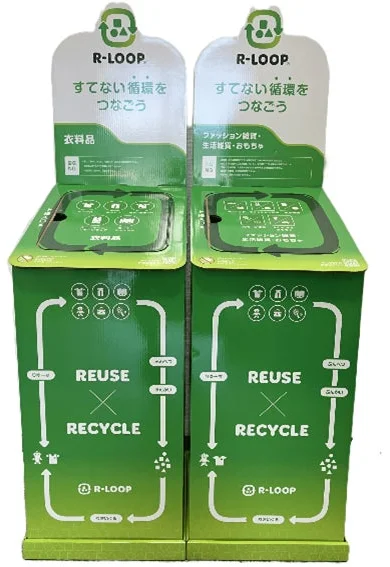
FamilyMart, a leading Japanese convenience store (widely known as a “Konbini”), and BOOKOFF, a company famous for buying and selling second-hand items, have joined forces. On April 13, 2026, they will launch a pilot program featuring “R-LOOP,” specialized in-store collection boxes for unwanted clothing and household goods.
The project will initially roll out in approximately 30 stores, primarily in the Setagaya and Suginami Wards—two of Tokyo’s most prominent residential areas. This groundbreaking initiative aims to turn the “Konbini,” an essential part of daily life in Japan, into a new gateway for resource circulation.
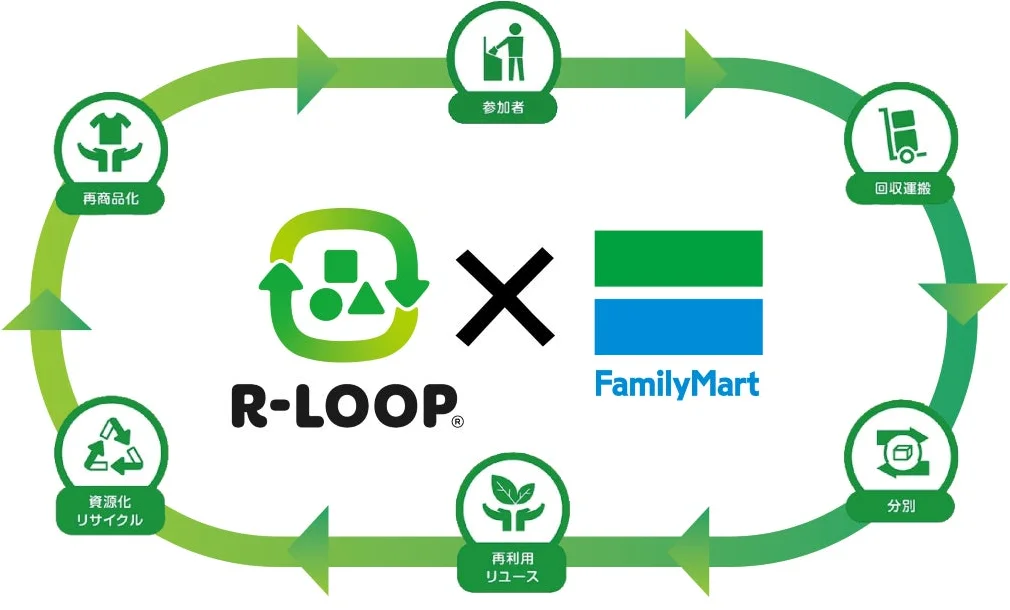
FamilyMart’s Challenge: Tackling Japan’s Clothing Waste Problem
Currently, approximately 560,000 tons (approx. 1.23 billion lbs) of clothing are disposed of annually in Japan through incineration or landfilling. The reality that items still fit for use are being thrown away has become a major social issue in the country.
Against this backdrop, FamilyMart and BOOKOFF co-founded “R-LOOP.” The goal is to create an environment where people who feel it is “wasteful to throw away items that are still usable” can easily participate in reuse and recycling as part of their daily routines.
FamilyMart already engages in community contribution activities, such as “Famima Food Drive,” which collects surplus food from households at approximately 4,900 stores across Japan. By expanding this strength into the apparel sector and partnering with BOOKOFF—experts in the reuse industry—they aim to build a society where anyone can effortlessly join the “Circular Economy.” With an eye toward a nationwide rollout in the future, the project targets an annual reduction of approximately 4,000 tons (approx. 8.8 million lbs) of clothing waste.
Done in 10 Seconds! Three Benefits of “R-LOOP”
The “R-LOOP” collection box is designed for busy modern lifestyles, making sustainability something that anyone can maintain.
1. A Hassle-Free Reuse Experience
The biggest advantage is the convenience; users simply drop their items into the in-store box. There is no need for the packing, shipping, or waiting for in-person appraisals required by typical reuse services. The ability to recycle “on the way” to buying a lunch box or coffee is a unique benefit of Japan’s ubiquitous convenience stores.
2. Traceability: Knowing Where Your Items Go
To address the concern of “what happens to the items I drop off,” the system ensures traceability. Collected items are resold through “Jalan Jalan Japan,” an overseas reuse shop operated by BOOKOFF. Clothing that does not meet reuse standards is properly recycled by partner companies. Every collection bag is managed via a database, ensuring a highly reliable system.
3. A Donation System That Contributes to Society
Simply by using the box, users participate in social contribution. Based on the volume of items reused, 1 yen (approx. $0.007 USD) per 1 kg (approx. 2.2 lbs) is donated to NPOs working on environmental protection and social issues. It is a wonderful cycle where unwanted items transform into funds for someone’s smile and a better society.
From Japan to the World! The New Journey of Collected Items
Items dropped off at FamilyMart generate new value through the following routes:
- 【Reuse】 Traveling Overseas to Malaysia, Kazakhstan, and More Clothing and goods that are still usable are transported to “Jalan Jalan Japan” stores abroad. “Used in Japan” items are highly popular internationally due to their reputation for high quality. Items that have finished their role in Japan find a second life with new owners.
- 【Recycle】 Regenerating into New Materials Clothing that is difficult to reuse is broken down to the fiber level. Currently, these items are transformed into “industrial rags” (wipers) for factories or “felt” (recycled fiber) used for cushioning. Research is also underway to develop technology to recycle these fibers back into products like new clothing, bags, and towels.
Rules for What Can and Cannot Be Collected
To ensure smooth operation, there are rules regarding which items can be accepted. Please check before visiting.
Items That CAN Be Collected
- All clothing (tops, bottoms, coats, etc.)
- Fashion accessories (bags, hats, belts, etc.)
- Household goods (towels, stationery, etc.)
- Toys and stuffed animals
- Sporting goods
Items That CANNOT Be Collected
- Heavily soiled or stained items
- Used masks, underwear, or base layers
- Broken or unusable items
- Home appliances and devices with built-in batteries
- Dangerous goods (blades, firearms, etc.)
- Food, drinks, cosmetics, and liquids
- General trash
Note: Once an item is placed in the box, it cannot be returned for any reason. Please double-check your pockets before dropping items off.
The “New Normal” Envisioned by Convenience Stores
Through this pilot program, FamilyMart will verify logistics efficiency and consumer demand. Depending on the results, these collection boxes may become a common sight at FamilyMart stores across Japan.
As FamilyMart approaches its 45th anniversary in 2026, “eco-friendly” initiatives are a core part of its strategy. Providing a way for anyone to easily do something good for the planet at a convenience store—a place integrated into daily life—FamilyMart’s new challenge to offer “value beyond convenience” is likely to attract attention from around the world.
Post a Comment